


Introduction: Stability Narratives versus Lived Realities
As Nigeria crosses the midpoint of 2026, the macroeconomic story is one of simultaneous progress and persistent fragility. Institutional reforms have delivered measurable fiscal and administrative gains; in practice, these achievements are colliding with entrenched structural constraints, foreign exchange-linked energy shocks and the early shadow of the 2027 election cycle. For analysts interrogating earnings resilience and policymakers grappling with sovereign balance sheet risk, the next twelve months will test whether recent reforms represent genuine inflection points or simply old vulnerabilities dressed in new policy language. The first half of 2026 (H1 2026) has already forced a recalibration of traditional macro models, as familiar anchors – cheap fuel, subsidised foreign exchange (FX) and benign debt dynamics – give way to tighter, more unforgiving fundamentals.
H1 2026 in Context: Global Fragmentation, Domestic Adjustment
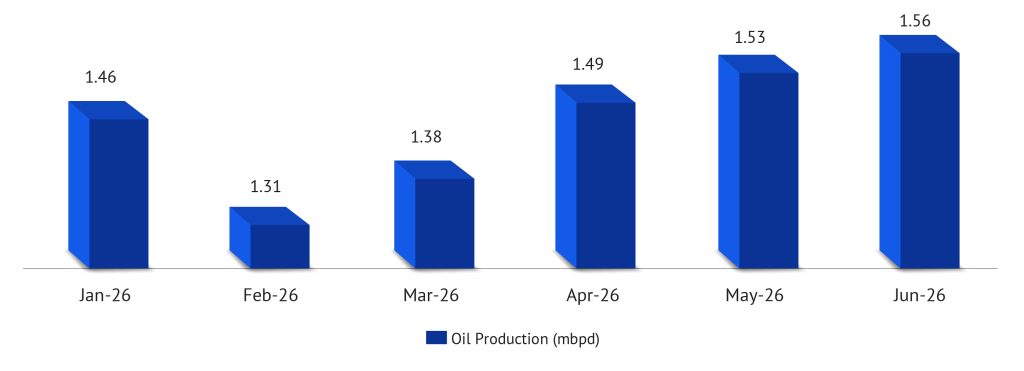
The global backdrop in H1 2026 remained fragmented, with subdued growth and persistent geopolitical tensions shaping commodity markets and capital flows. For Nigeria, this translated into a volatile but broadly supportive Brent crude oil price environment, offering a welcome – if uneven – cushion for external balances. Upstream interventions and intensified security operations lifted crude and condensate output towards 1.9 million barrels per day (mbpd), underpinning a rise in gross external reserves to around $51.4 billion as at the end of June 2026. Yet this positive headline obscures a more complex reality: net FX liquidity remains strained, and imported inflation pressures continue to build as global supply chain realignments drive up the cost of intermediate inputs critical to domestic manufacturing and agro-processing.
Figure 1: Nigeria Oil Production – Million Barrels per Day (mbpd)
Source: National Bureau of Statistics
Fiscal Dynamics: Administrative Breakthroughs, Balance Sheet Constraints
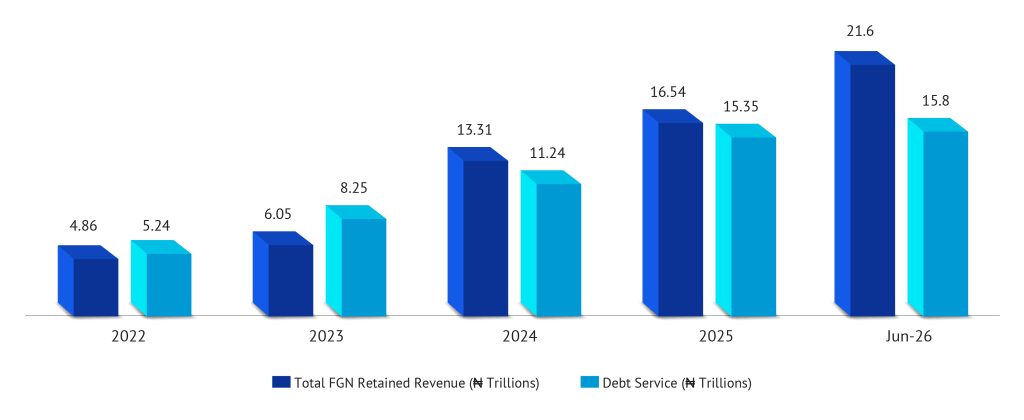
Nigeria’s fiscal narrative in H1 2026 was defined by a sharp contrast between unprecedented revenue mobilisation and an increasingly onerous debt overhang. The sovereign debt stock has crossed the ₦150 trillion mark, propelled not only by fresh borrowing but also by exchange rate depreciation, which mechanically inflates the naira value of foreign obligations. Debt service costs now threaten to approach ₦15.8 trillion annually, absorbing a disproportionate share of retained revenues and crowding out the fiscal space for meaningful capital expenditure.
Figure 2: FGN Retained Revenue vs Debt Service (₦ Trillion)
Source: IMF Article IV 2026, The Presidency Economic Snapshot Report (July 2026)
Against this backdrop, the performance of the newly constituted Nigeria Revenue Service (NRS) stands out as a genuine reform dividend. First-half collections surged by approximately 49% year-on-year to ₦21.6 trillion, driven by tax administration digitisation, institutional consolidation and the nationwide roll-out of e-invoicing for large taxpayers. Non‑oil taxes now contribute roughly 76% of total collections, pushing the tax-to-GDP ratio from about 10.3% in mid‑2023 to near 13%. The enforcement of Executive Order 9, mandating direct remittance of upstream royalties and taxes to the Federation Account, has also narrowed longstanding leakages in the oil value chain. However, the spike in revenue is being largely consumed by the elevated cost of governance, higher wage commitments and the swelling debt service burden. In effect, administrative efficiency has bought time but not sustainability. Without a deliberate strategy to arrest debt accumulation and restructure servicing dynamics, the fiscal architecture risks producing a modern collection system grafted onto a still-vulnerable funding model.
Monetary Policy and Yield Dynamics: Unshackled but Restrictive
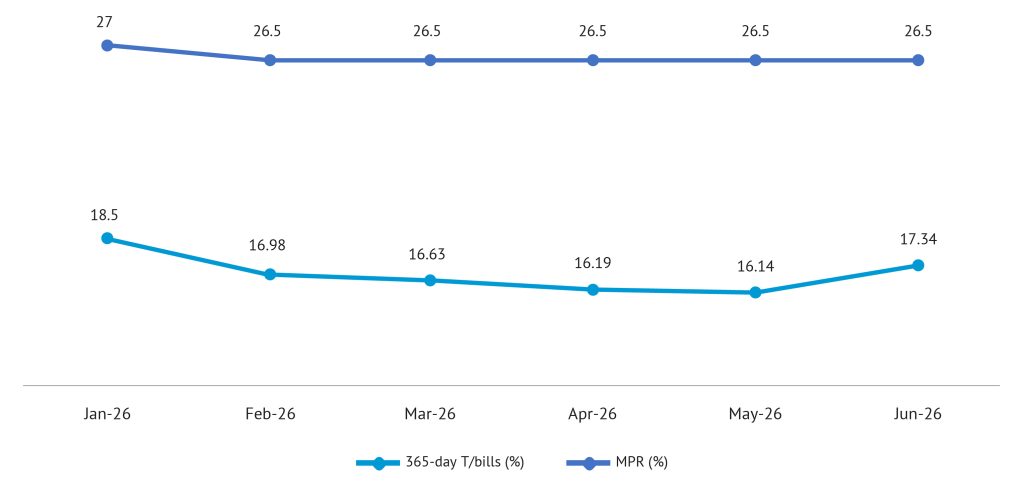
In H1 2026, the Central Bank of Nigeria (CBN) maintained a distinctly hawkish posture, even as it introduced a measured adjustment to its policy stance. At the 304th MPC meeting in February, the Bank reduced the Monetary Policy Rate (MPR) by 50 basis points – from 27.0% to 26.5% – signalling cautious confidence in a disinflationary trend while keeping overall financial conditions tight. The combination of this modest cut with continued intensive liquidity mopping via Open Market Operations and elevated Cash Reserve Ratios sustained domestic yields at historically high levels, preserving attractive net interest margin opportunities for banks and fixed‑income investors.
Figure 3: Monetary Policy Rate (%) vs 365-day Treasury Bills (%)
Source: The CBN
While the tightening cycle coincided with some moderation in month‑on‑month price growth towards the end of Q2, year‑on‑year headline inflation has yet to demonstrate a decisive downward trend. Headline inflation, which eased to 15.10% in January 2026, climbed back to 15.93% by May on higher energy costs and only edged down to 15.91% in June, indicating that price pressures remain stubbornly elevated despite the marginal easing in the policy rate. This monetary posture has manifested itself in the real economy as sharply rising naira‑denominated interest costs, with aggregate debt‑servicing outlays projected at approximately ₦15.8 trillion in 2026 – further tightening the squeeze on both sovereign and corporate balance sheets.
For the real sector, the impact remains restrictive. Despite the marginal rate reduction, the cost of capital is still prohibitive for most productive enterprises, constraining private‑sector credit creation and dampening investment appetite. In effect, Nigeria’s monetary transmission mechanism is fully engaged – policy decisions are clearly influencing funding costs and portfolio behaviour – but the regime continues to prioritise price and FX stability over growth, reinforcing the perception that inflation is being addressed predominantly through demand compression rather than complementary supply‑side reforms.
FX Market: Managed Calm, Structural Pressure
Efforts to unify and stabilise the foreign exchange regime have produced a fragile equilibrium, with the naira trading within the ₦1,350–₦1,500/US$ corridor in H1 2026. Enhanced market transparency, higher remittance inflows and periodic CBN interventions have smoothed some of the extreme volatility seen in previous periods. Available evidence from the IMF’s external sector assessment suggests that structural FX needs (imports and debt service) remain high relative to Nigeria’s still‑narrow export base, indicating that FX supply is likely to remain tight even as market functioning improves. Structural import dependence, sizeable sovereign and corporate FX obligations, and the absence of truly diversified export earnings continue to weigh on the currency. The risk is that the apparent stability may be misinterpreted as equilibrium, when in reality it reflects a managed compromise. In such a context, any adverse shock, whether global risk-off sentiment, domestic political uncertainty or energy sector disruption, could quickly surface in renewed exchange rate weakness and, by extension, higher inflation via the now‑immediate downstream fuel pass‑through channel.
H2 2026: The Liquidity Shadow and Structural Shock
Global Backdrop: Geopolitical Risk and the Brent Price Path
The global macroeconomic backdrop for H2 2026 is dominated by the recent collapse of the US–Iran ceasefire and the ensuing geopolitical premium on energy markets. With persistent shipping disruptions along the Strait of Hormuz, we anticipate that Brent crude will hover near the $80–$90 per barrel corridor $100 per barrel through Q4 2026, with upside scenarios of $95–$115 per barrel if disruptions persist. While this elevated price path bolsters Nigeria’s gross external reserves and sovereign revenue, it simultaneously amplifies domestic headwinds. Under the newly implemented USD-benchmarked downstream regime, a sustained $100 per barrel crude environment guarantees severe cost-push inflation, transmitting Middle Eastern geopolitical volatility directly into Nigeria’s transport, logistics, and retail supply chains.
Debt Accumulation and Electioneering: The Threat of Fiscal Dominance
As the 2027 election cycle edges closer, the risk profile of Nigeria’s public finances is shifting. Historically, pre‑election periods have been associated with elevated recurrent spending, politically motivated projects and relaxed fiscal discipline. With the debt stock already high and servicing costs elevated, any further drift into deficit‑financed electioneering could tip the system towards fiscal dominance, where monetary policy is persistently subordinated to the imperative of funding government operations. The unprecedented ₦21.6 trillion H1 revenue collection provides a critical buffer, but the Federal Government’s reliance on aggressive domestic borrowing to finance a recurrent‑heavy budget deficit remains a serious vulnerability. Should the authorities lean into high‑yield domestic instruments to finance Q4 political spending, the consequences would be twofold: a near‑total crowding out of private‑sector borrowers and the entrenchment of a vicious debt‑servicing cycle that could outpace even the most ambitious tax reform outcomes. For fixed‑income analysts, this scenario points to sustained elevated yields; for policymakers, it signals the encroaching risk of fiscal dominance, where monetary policy becomes increasingly subordinated to funding exigencies.
Macroeconomic Anchors: Tracking the Quantitative Projections
Looking ahead to the second half of 2026, GDP growth is set to remain uneven across sectors. Financial services and telecommunications are poised to sustain expansion, buoyed by high-yield environments, digital adoption and platform-based business models that are relatively asset-light. In addition, the recently concluded banking sector recapitalisation, under which most lenders raised ₦4.6 trillion in new paid‑up capital to meet steep CBN thresholds, has materially strengthened balance‑sheet resilience and, over the medium term, will enhance capacity to support larger credit portfolios once risk appetite normalises. On the insurance side, the July 2026 recapitalisation deadline has now passed, with NAICOM’s verification drive consolidating weaker firms and reinforcing the capital base of survivors, thereby improving their ability to underwrite larger risks and deepen penetration across corporate and retail segments.
These segments are likely to continue posting robust nominal growth, reinforcing their position at the apex of the corporate hierarchy. In contrast, manufacturing and agriculture face a more challenging outlook. Elevated energy costs, FX-linked input prices and expensive credit will constrain capacity utilisation and investment in these sectors. Without targeted de‑risking mechanisms – such as credit guarantees, sector‑specific funding windows or structured value chain support – real sector growth will underperform, with implications for employment and inclusive development.
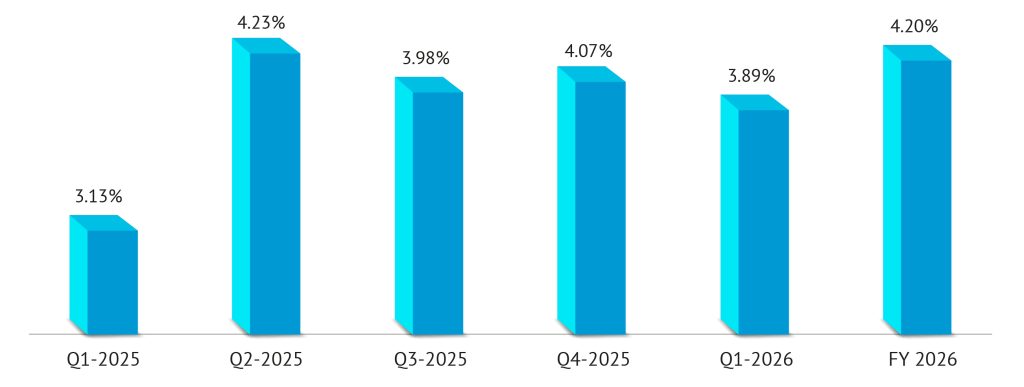
Figure 4: GDP Growth (%)
Source: NBS, Agusto & Co. forecast
Overall, we believe Nigeria’s growth trajectory heading into H2 2026 points to a moderately firm yet structurally bounded expansion. We forecast a 4.2% GDP growth for full year 2026, which aligns with consensus projections from the IMF and World Bank of a narrow band of around 4.0–4.4%, modestly above both global (3.1%) and Sub‑Saharan Africa (3-4%) averages. The danger is a growth pattern that generates substantial nominal value without translating into broad-based prosperity, thereby exacerbating inequality and social vulnerability. In the foreign exchange market, we expect the naira to continue to oscillate within a corridor of ₦1,350/$–₦1,465/$. While steady CBN interventions and high-yield-seeking foreign portfolio investments provide a floor, sovereign debt obligations will cap any aggressive appreciation. Providing a modest buffer to this currency management, gross external reserves are projected to trend toward the $53 billion mark by year-end, supported by sustained upstream oil production and relatively stable global crude prices.
For inflation, the outlook remains stubbornly elevated. We estimate a year-end figure of between 17.0% and 18.0%, reflecting ongoing energy‑related cost pressures, FX pass‑through from downstream dollar pricing and still‑tight supply‑side conditions. In this context, cost‑push forces are expected to dominate the inflation narrative, with any gains from monetary tightening constrained by structural bottlenecks in power, logistics and domestic production. On the monetary policy front, we expect the CBN to maintain a cautious stance, holding the MPR at 26.5% throughout H2 2026. Rather than resorting to further rate hikes, we anticipate a heavy reliance on OMOs and CRR adjustments to aggressively mop up the anticipated pre-election liquidity surge.
Strategic and Policy Implications: Discipline under Political Pressure
A central question for H2 2026 is whether Nigeria’s fiscal and monetary authorities can maintain policy alignment as the 2027 political cycle gathers momentum. For policymakers, enforcing spending discipline and adhering strictly to established domestic borrowing frameworks remain the only viable safeguards against a resurgence of demand‑driven price instability.
Energy–Currency Mismatch: A Structural Fault Line
The evolving friction in the downstream energy market illustrates a deeper structural fault line: Nigeria’s heavy reliance on imported or FX‑linked fuel in a context of currency vulnerability. The adoption of USD‑benchmarked ex‑depot pricing has effectively removed the temporal buffer between FX movements and domestic cost structures. Each shift in the naira corridor now cascades swiftly into transport fares, goods distribution costs and, ultimately, retail prices.
Resolving this mismatch will demand coordinated action between the Federal Government, NNPC Limited and private refiners. A transparent, rules‑based framework for naira‑denominated crude supply – anchored by clear pricing formulas, predictable allocation volumes and robust governance – could help reintroduce some stability into downstream operations. Without such a framework, fuel will continue to function as a high‑velocity transmission channel for exchange rate volatility, amplifying inflation and complicating macroeconomic management.
Narrow Pathways, High Stakes
The remainder of 2026 offers limited room for administrative missteps or corporate complacency. For the analyst community, incorporating FX‑indexed energy costs, elevated borrowing rates and election‑related fiscal behaviour into baseline models is no longer optional; it is essential for credible forecasting and risk assessment. For sovereign managers, the task is twofold. First, they must consolidate the gains from recent tax and administrative reforms, ensuring that digital systems and institutional harmonisation permanently close historic leakages rather than merely shifting them. Secondly, they must resist the allure of new statutory burdens that could undermine compliance and stifle formal sector growth. The balance to be struck is between deeper revenue mobilisation and a stable, predictable operating environment for businesses.
In the absence of a decisive pivot in execution, H2 2026 will be characterised by tight fiscal conditions, high funding costs and persistent inflation risks. Success, therefore, will hinge less on the announcement of new reforms and more on the sober, disciplined implementation of existing frameworks. In this sense, Nigeria’s macroeconomic trajectory over the coming months will reveal whether recent changes amount to genuine structural renewal – or simply another iteration of new policy bottles filled with old, unresolved economic wine.