

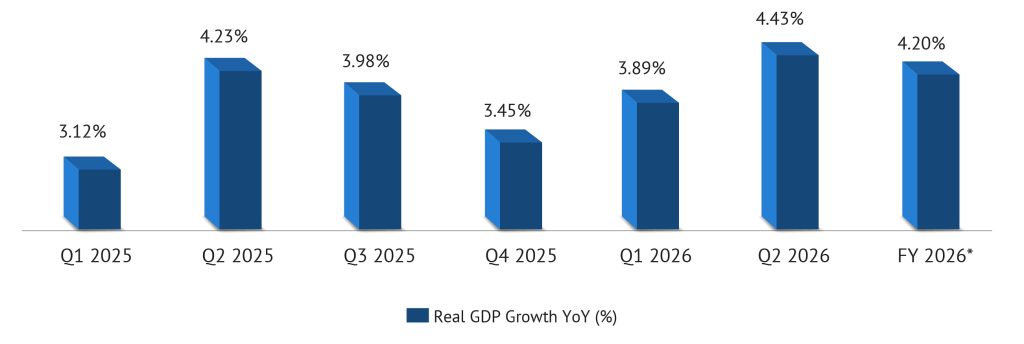
Nigeria’s economy expanded by 4.43% year-on-year in real terms in the second quarter of 2026, accelerating from 3.89% in Q1 and exceeding the 4.23% recorded in Q2 2025. On the surface, the result is encouraging. It is the clearest indication yet that the economy is moving beyond the difficult adjustment phase that followed the reforms of 2023. Oil production has recovered, the naira has steadied and headline inflation has declined materially from 2025 levels.
Figure 1: Nigeria’s GDP Growth rate (%)
Source: National Bureau of Statistics (NBS)
Yet, as is often the case with Nigerian macroeconomic data, the headline number only tells part of the story. The more important question is whether the recovery is spreading into the sectors that employ the largest number of Nigerians, support small businesses and raise household incomes. It is one thing for GDP to grow; it is another for that growth to become visible in the everyday experience of businesses and households.
The Q2 data suggest that the economy is stabilising. Whether it is becoming sufficiently inclusive, employment-rich and productive is less clear.
The Growth-Quality Question
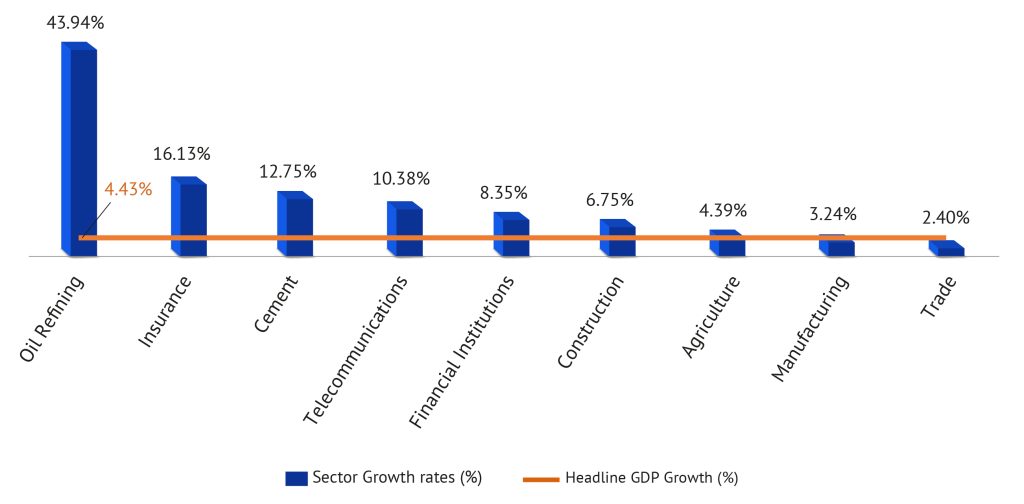
Nigeria’s Q2 performance should be assessed by the composition of growth, not merely its pace. Services remained the largest part of the economy, accounting for 56.62% of real GDP and growing by 4.60%. Agriculture represented 26.15% and expanded by 4.39%. Industry, which accounted for 17.23%, grew by only 3.96%, a marked slowdown from 7.46% a year earlier. Sectors with stronger employment and enterprise linkages did not expand as quickly as the headline rate. Trade grew by 2.40%, manufacturing by 3.24% and industry by 3.96%, all below aggregate GDP growth. Construction was an important exception, expanding by 6.75%, while agriculture grew broadly in line with the economy. Still, the sectoral picture does not yet suggest an unequivocally employment-rich recovery.
GDP data alone cannot determine the number, quality or income level of jobs created. That requires current labour-force, earnings, poverty and household-consumption data. However, the evidence raises an uncomfortable possibility: aggregate output may be expanding faster than employment opportunities, real incomes and purchasing power – what most would call growth without development. Nigeria therefore needs to judge the recovery by its impact on productive activity, not simply by what it adds to national output.
Oil Rebounds but cannot carry the economy
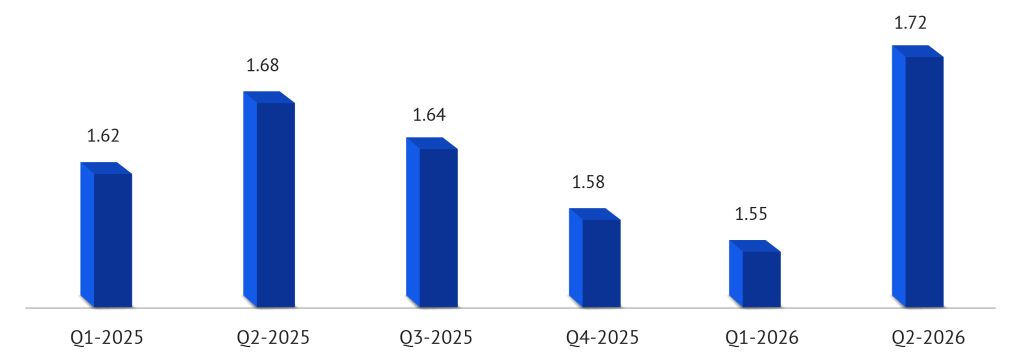
The oil sector grew by 7.31% in Q2 2026, compared with 2.57% in Q1. Crude oil production rose to around 1.72 million barrels per day (mbpd), from 1.55 mbpd in the preceding quarter and 1.68 mbpd in Q2 2025. We consider this positively given the contribution of oil to Nigeria’s fiscal and external position although it only accounted for 4.16% of real GDP.
Figure 2: Oil Production (Million Barrels Per Day)
Source: NBS
However, oil cannot resolve Nigeria’s employment challenge. It is capital-intensive, geographically concentrated and exposed to theft, pipeline disruptions, operating failures and global oil-price volatility. It can provide the foreign exchange that enables the broader economy to function, but it cannot replace jobs in manufacturing, agriculture, construction, trade and small business activity. The non-oil economy accounted for 95.84% of real GDP and grew by 4.31% in Q2. This remains the more important number. Nigeria’s future will be determined by what happens outside oil. The policy objective should be to use the fiscal and FX space created by stronger production to support investment in productive non-oil sectors. Without this shift, Nigeria could achieve macroeconomic stability without developing the productive base necessary for durable, broad-based growth.
Agriculture improves, but Food Prices tell another Story
Agriculture was among the quarter’s stronger sectors. It expanded by 4.39%, compared with 2.82% in Q2 2025. Crop production grew by 3.66%, while livestock expanded by 6.92%. This matters because agriculture is not merely a GDP category. It supports rural livelihoods, supplies domestic industry and remains central to food security.
A sustained recovery in agricultural output could raise rural incomes, support agro-processing and improve food supply. However, higher farm output should not be confused with immediate improvement in food affordability. Food inflation rose for the 5th consecutive month to reach 20.31% year-on-year in July 2026, even as headline inflation fell to 15.43%. Nigeria’s food challenge is therefore about more than producing crops. It is also about moving food safely, efficiently and cheaply from farms to consumers. Rural security, irrigation, storage, cold chains, aggregation centres and transport corridors are as important as farm output if agricultural growth is to become a source of lower food prices and inclusive welfare gains.
Agriculture delivered one of the quarter’s clearest positive surprises. Real growth accelerated to 4.39% from 2.82% a year earlier, with crop production expanding by 3.66% and livestock by 6.92%. The improvement is noteworthy given the sector’s structural constraints, including insecurity, high input costs, climate change, limited irrigation, and weak logistics infrastructure. Yet the stronger Q2 performance suggests that supply-side conditions have improved sufficiently to support a faster expansion in output. Beyond GDP data, Agriculture has one of the strongest links to household welfare because it affects both rural income and domestic food supply. A stronger agricultural sector can therefore support economic growth while simultaneously helping to moderate food-price pressures over time, a problem that persists, as highlighted through food inflation, which rose for the 5th consecutive month to reach 20.31% in July 2026.
Figure 3: Sectoral Growth vs. Headline GDP (Q2 2026)
Source: NBS
Services Keep the Economy Moving
Services remained the largest part of the economy and grew by 4.60% in Q2 2026. Information and communication expanded by 9.62%, financial and insurance services by 9.29%, arts, entertainment and recreation by 11.93%, and transport and storage by 5.70%. Telecommunications and information services grew by 10.38%, supported by rising data usage, digital payments, online commerce and the lingering effect of tariff adjustments. Financial institutions expanded by 8.35%, while insurance grew by 16.13%. These outcomes are positive. Telecommunications reduces information and transaction costs. Digital platforms broaden market access. Financial services support payments, capital mobilisation and formalisation, while insurance strengthens risk management.
However, services-led growth has limits. Banking, insurance and telecommunications can expand through higher fees, tariffs, margins and technology adoption even when household incomes are under pressure. Their growth does not necessarily create the same employment multiplier as manufacturing, trade, construction value chains, transport or agro-processing. The Trade sector illustrates the issue. As one of Nigeria’s largest activities and a major source of self-employment and informal livelihoods, it grew by only 2.40%. While this was better than the 1.29% recorded in Q2 2025, it remained well below headline GDP growth. Nigeria needs strong digital and financial services, but these should increasingly enable businesses that make, process, move and sell goods. If services grow without comparable acceleration in production and commerce, the recovery will remain narrow.
Industry Remains the Weak Link
Industry grew by 3.96% in Q2 2026, down from 7.46% a year earlier. Manufacturing expanded by 3.24%, better than the 1.60% recorded in Q2 2025 but still below headline GDP growth. Manufacturing’s share of real GDP edged down to 7.72% from 7.81% a year earlier. This is below the industrial performance expected of an economy seeking to create jobs at scale, reduce import dependence and achieve meaningful productivity gains. Manufacturing is where agricultural output becomes processed food, local raw materials become finished goods and supplier networks can deepen. Instead, manufacturers remain constrained by unreliable electricity, expensive self-generation, high borrowing costs, FX-sensitive machinery and inputs, logistics bottlenecks, imported competition and weak consumer demand. The contraction in electricity supply – by 10.63% y-o-y – is especially disturbing as it highlights the continued weakness of the electricity supply industry and the extent to which businesses continue to rely on costly self-generation.
Nonetheless, there were positive pockets. Oil refining grew by 43.94%, cement expanded by 12.75%, while chemical and pharmaceutical products rose by 7.70%. These results show what is possible when capital investment, market demand and policy conditions align. Domestic refining is especially important. Higher local capacity is already reducing reliance on imported petroleum products, lowering associated FX demand and improving fuel availability. Yet the gains must be sustained through reliable crude supply, commercially sound pricing, operational efficiency and high-capacity utilisation.
Headline inflation fell to 15.43% in July 2026, from 15.91% in June and 24.94% a year earlier. Core inflation declined to 14.97%. This is among the clearest signs that macroeconomic conditions are improving. However, falling inflation does not mean that prices are falling. It means they are rising more slowly. For households that have experienced several years of rising food, rent, transport and utility costs, that distinction is critical. Food inflation of 20.31% remains troubling because food accounts for a large share of lower-income household expenditure. The CBN has adopted a cautious stance. Having cut the Monetary Policy Rate by 50 basis points to 26.5% in February 2026, it held rates at its May and July meetings. The logic is understandable: premature easing could weaken the naira, undermine FX-market confidence and reignite imported inflation. The cost is that high interest rates and a 45% cash reserve ratio (CRR) restrict credit to manufacturers, agricultural enterprises, construction firms and smaller businesses. The policy challenge is to preserve macroeconomic stability while improving access to long-term, productive finance.
The Naira Appreciated, then found Relative Stability
The naira’s relative stability during Q2 2026 followed an earlier period of appreciation. Having opened the year near ₦1,420/$, the currency strengthened to around ₦1,333/$ in February before settling within a comparatively narrow ₦1,360/$-₦1,380/$ band through Q2 2026. A more stable naira allows businesses to plan, reduces uncertainty over imported inputs and foreign-currency obligations, moderates exchange-rate pass-through to consumer prices and supports confidence. The stability has been supported by stronger oil receipts, FX-market reforms, remittance formalisation and rising foreign portfolio investment – to $9.8 billion in Q1 2026, up 89.49% year-on-year.
Yet portfolio capital is not the same as durable foreign direct investment (FDI), remittances or export earnings. It can reverse quickly if global financial conditions change or domestic confidence weakens. Sustaining naira stability will require higher oil output, stronger non-oil exports, reserve accumulation, disciplined fiscal policy and continuing FX-market reform.
Election Season Is Approaching
The next major test for the recovery will be political. INEC has fixed the presidential and National Assembly elections for 16 January 2027, with governorship and state assembly elections scheduled for 6 February 2027. The earlier timetable means that election-related spending could begin to influence the economy as early as Q4 2026. Campaign activity, security spending, procurement, public works commissioning and travel could provide a short-term boost to trade, transport, hospitality, communication and construction. This could support growth in the near term. But it could also threaten the stability that has taken time to rebuild. If election-related expenditure becomes excessive or poorly financed, it could place pressure on liquidity, inflation and the naira. The CBN may then be forced to remain restrictive for longer, delaying the recovery in credit-dependent sectors. Nigeria has seen this story before. The question is whether the current administration can preserve macroeconomic discipline while navigating the incentives of an election cycle.
On a Final Note
Nigeria’s Q2 2026 GDP result is more encouraging than the headlines suggest, though the headline growth rate does not tell the full story. The economy is more stable than it was a year ago: oil output is stronger, the naira has strengthened, headline inflation is lower and non-oil activity remains resilient. Moody’s decision to revise Nigeria’s outlook to positive from stable, while affirming its B3 rating, reflects the improved external position and stronger growth outlook. However, it also recognises persistent concerns around fiscal pressure, weak public revenue and debt affordability.
The greater challenge is what happens next. Nigeria does not simply need higher GDP growth; it needs growth that creates jobs, raises productivity, produces goods, earns foreign exchange and improves household welfare. The recovery will become more meaningful when manufacturers can operate competitively, food can move from farms to markets at lower cost, trade expands more quickly, smaller businesses can access finance and GDP growth becomes visible not only in national accounts but also in household incomes.
For now, Nigeria’s economy is on firmer ground. Whether that ground becomes a platform for transformation, rather than merely a pause between periods of instability, remains to be seen.