

The Electricity Act 2023 has given state governments greater scope to shape Nigeria’s electricity market. States can establish regulatory commissions, license intrastate electricity businesses and develop supply arrangements tailored to local demand. The opportunity is considerable: bring investment decisions closer to consumers, improve service accountability and create commercially viable markets around identifiable demand centres. However, regulatory devolution alone does not resolve the weak collections, unfunded subsidies, and political interference that have undermined the national system. A smaller electricity market is not necessarily better run. Unless the incentives governing payment, investment and regulation change, states could reproduce familiar problems within jurisdictions with less financial capacity to absorb them.
The challenge is therefore to make local electricity markets bankable without undermining the financial viability of shared infrastructure. Well-structured arrangements could improve industrial productivity and broaden reliable supply. Poorly designed markets could instead entrench a two-tier electricity economy: dependable power for commercially attractive customers and a deteriorating network for those unable to finance alternatives.
Autonomy without Independence?
The 2023 constitutional amendment and Electricity Act expanded state participation beyond areas outside national-grid coverage. States can establish electricity laws and regulators, subject to the statutory process for transferring oversight from the Nigerian Electricity Regulatory Commission (NERC). This represents a redistribution of regulatory responsibility, not the introduction of private participation into a previously exclusive federal monopoly. Crucially, the framework does not divide Nigeria into entirely independent electricity systems. Federal oversight remains relevant to national-grid supply and interstate transactions. A state purchasing bulk electricity from the national grid remains exposed to upstream generation costs, transmission constraints and settlement obligations. Its regulator may determine retail tariffs, but it cannot legislate away the cost of externally supplied electricity.
The ongoing transition in Akwa Ibom State illustrates the distinction between receiving a transfer order and completing a transition. NERC issued its order on 18 August 2026, with completion scheduled for 17 February 2027. The incumbent utility, Port Harcourt Electricity Distribution Plc, is now required to establish a subsidiary and allocate relevant assets, liabilities, contracts, and employees to its Akwa Ibom operations. Boundary metering is also required where the network crosses neighbouring states. These are substantive commercial requirements, not administrative formalities. Lagos State offers another illustration of institutional progress. On 6 August 2026, its regulator licensed the Lagos Independent System Operator, whose responsibilities include dispatch coordination, congestion management, and wholesale-market administration. The licence is an important milestone, but operational effectiveness depends on market rules, technical arrangements, and coordination with the national system. The proposed Lagos 24/7 Energy Zones pilot reinforces this interdependence. Its joint technical framework brings federal and state institutions together to address grid stability, liquidity and network expansion. State autonomy is being tested through coordination, not separation.
Emerging markets therefore require credible opening balance sheets, accurate customer records and clearly assigned responsibilities. Disputed liabilities or inadequately measured cross-border flows could introduce new settlement problems before historical arrears are resolved. Customer transfers also require careful interpretation. Allocating customers to a state subsidiary is not necessarily grid defection. The financial consequences depend on whether associated assets, costs and liabilities move with them. Devolution becomes problematic when revenues migrate, but the obligations they previously supported remain elsewhere.
Who will Finance the Transition?
The economic case for state markets rests on matching dependable supply with identifiable customers who can pay. Industrial estates, commercial districts, hospitals, universities and logistics hubs can provide anchor demand for dedicated generation and distribution investment. For manufacturers, the relevant benchmark is the total cost of unreliable electricity, not the published grid tariff alone. Generator fuel, maintenance, damaged equipment, lost production and spoiled inventory all affect operating margins. A dedicated supply contract may carry a higher nominal tariff while reducing the effective cost of sustaining production. Businesses may therefore pay a premium where better service delivers measurable savings. Demand alone, however, does not establish bankability. Investors need confidence that electricity delivered will translate into revenue received. Dedicated metering, enforceable contracts, defined collection arrangements and credible payment security are essential. The opportunity lies in ring-fencing the payment chain, not merely the power plant. A project supplying an identifiable industrial cluster may offer more transparent cash flows than broad exposure to the national market’s collection weaknesses. Physical infrastructure addresses delivery constraints; contractual and financial arrangements address revenue risk. Both are necessary.
Figure 1: ATC&C losses across Nigeria’s DisCos in 2025 (%)
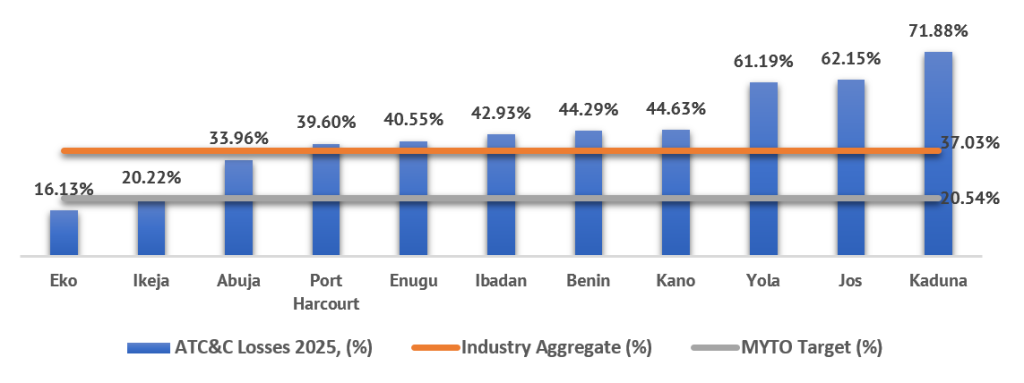
Source: NERC 2025 Annual Report
Embedded generation can reduce exposure to transmission constraints by connecting supply directly to the distribution network, potentially closer to demand. But proximity does not guarantee uninterrupted electricity. Projects still require dependable fuel, adequate network capacity, maintenance and backup arrangements. Connecting new generation to an overloaded local network merely relocates the bottleneck. We expect investors to distinguish between demand density and market readiness. A large urban market is not necessarily financeable if tariff adjustments remain discretionary, contracts are difficult to enforce, or public institutions routinely default. States should consequently procure measurable service outcomes rather than headline generation capacities. Developers should demonstrate delivered energy costs, availability commitments, network requirements and financing arrangements against realistic demand and payment assumptions. State guarantees should be evaluated against their fiscal implications, not treated as substitutes for project viability. Equally, ring-fenced projects must pay legitimate charges for shared infrastructure. Local solvency achieved by transferring costs to another entity would improve a project’s accounts without strengthening the wider sector.
Cheap Power, Unpaid Bills?
Retail tariffs will provide the clearest test of sub-national commercial discipline. Electricity revenues must recover efficient generation, network, operating and financing costs. Where governments choose to charge consumers less, the difference requires an identifiable funding source. Otherwise, affordability becomes an unpaid obligation carried by utilities and suppliers. The Enugu tariff debate demonstrates this constraint. In July 2025, NERC challenged a state directive that unilaterally reduced Mainpower’s Band A tariff to ₦160.4 per kWh. According to NERC’s analysis, the calculation arbitrarily compressed the average generation-cost component from ₦112.60 to ₦45.75, implying an unbudgeted, assumed subsidy of ₦66.85 per kWh. NERC firmly established the precedent that state tariffs must incorporate wholesale grid costs or provide direct state funding for the deviation.
Statutory authority over retail pricing does not confer the macroeconomic authority to rewrite the underlying economics of externally generated power. A state administration is at liberty to subsidise its constituents, but it must explicitly identify the funding vehicle. Otherwise, the illusion of affordability in one jurisdiction creates immediate liquidity shortfalls elsewhere in the interconnected value chain. Sub-national political proximity exacerbates this challenge. State executives and regulators face direct pressure from households, traders and employers dissatisfied with electricity bills. As the 2027 elections approach, necessary adjustments could become particularly contentious. Promising better supply while postponing the revenue measures required to finance it would recreate the liquidity problems decentralisation is intended to address.
In our view, affordability protection must be separated from utility solvency. Support for vulnerable consumers should be targeted, explicitly appropriated and disbursed on schedule. Eligibility and fiscal exposure should be verifiable. Blanket tariff suppression benefits customers regardless of need while leaving utilities dependent on payments governments may struggle to honour. Regulatory independence must also extend beyond tariff-setting. Political influence over licensing, procurement, sanctions or treatment of connected customers can undermine an otherwise credible framework. Appointment procedures, secure funding, published decisions and consistent enforcement are essential safeguards.
Consumers should not, however, finance avoidable inefficiency indefinitely. Cost-reflective tariffs require transparent cost reviews, loss-reduction targets, metering obligations and enforceable service standards. Commercial discipline must bind suppliers and public institutions as firmly as it binds households. Similarly, gas contracts require dependable supply, payment security and explicit allocation of currency risk. Dollar denomination may protect suppliers, but it does not make a project bankable where revenues are earned in naira and exchange-rate exposure remains unresolved.
Solar Gains, Network Strains
As state markets open up, new entrants and independent power producers will naturally target consumer demographics exhibiting concentrated demand and robust payment capacity. This commercial cherry-picking becomes a profound systemic threat when customer migration strips revenue from the legacy utility far faster than it removes fixed operational costs. A Distribution Company (DisCo) may lose its most lucrative industrial and residential off-takers to state-franchised mini-grids, while retaining a vast, depreciating physical infrastructure and a highly challenging, loss-making rural collection portfolio. Distributed solar adds another dimension. Nigeria imported approximately 2,370MW worth of clean energy equipment between 2025 and April 2026. While gross import data is not perfectly equivalent to commissioned capacity, it signals a profound, unstoppable market momentum toward grid independence. The commercial and industrial sector is aggressively voting with its capital to escape grid volatility.
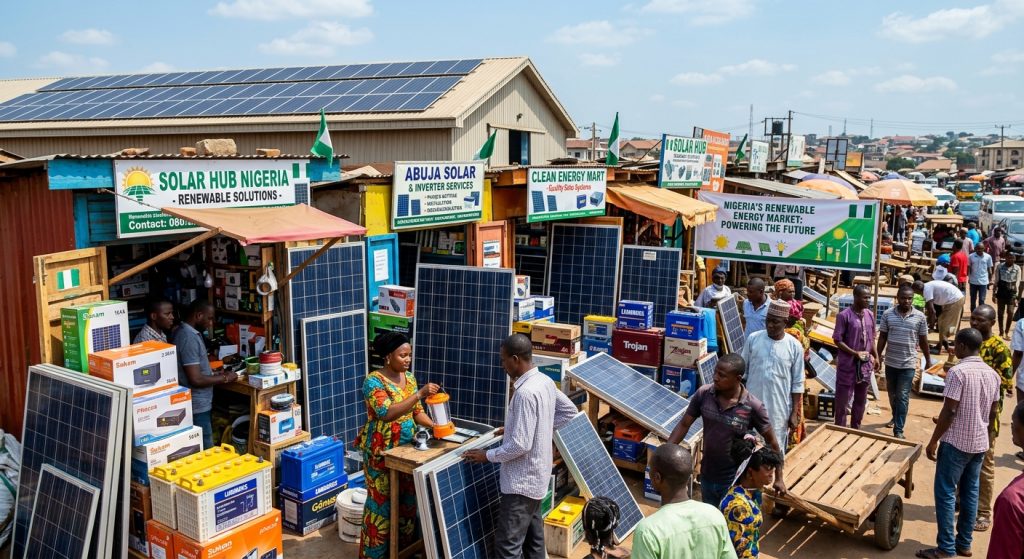
Solar panels on the roof. (Solar cell)However, partial self-generation poses a far more complex network-funding dilemma than complete grid defection. A commercial off-taker may entirely replace its daytime grid purchases with captive solar, yet retain its grid connection to service evening demand, charge battery backup systems, or bridge seasonal weather shortfalls. The utility’s volumetric energy sales aggressively decline, yet the physical infrastructure must remain fully maintained and instantly available to meet peak demand when the sun goes down. If fixed network maintenance costs continue to be recovered primarily through volumetric energy charges, a solar-enabled customer’s financial contribution to the grid will plummet, despite their ongoing reliance on the grid for standby service. This revenue compression restrains the utility’s ability to conduct routine maintenance. The resulting deterioration in service quality then incentivises even further self-generation among the remaining customers, triggering a classic utility “death spiral”.
The recent trajectory of Pakistan’s electricity sector offers a highly relevant cautionary precedent. Rapid, middle-class solar adoption heavily reduced participating consumers’ reliance on the central grid, while sovereign capacity charges and conventional generation obligations remained rigidly fixed. This placed catastrophic financial pressure on the remaining, poorer non-solar consumers and forced policymakers to hurriedly propose punitive grid-maintenance surcharges for solar users. Nigeria must internalise the mechanics of this crisis before it fully manifests here. Future tariff architectures must clearly unbundle raw energy purchases from legitimate network-access and standby-capacity services.
New Markets, Different Outcomes?
A practical alternative to complete customer exit is to improve supply through existing networks. Competitively structured feeder-management partnerships could combine private investment in metering, collections and embedded generation with measurable service obligations. Customers would retain their network relationship while benefiting from improved local supply. Such arrangements require transparent asset access, revenue allocation and consumer protection. Lagos’s incumbent DisCos have reportedly committed to increased electricity offtake under the pilot. This could strengthen existing networks rather than encourage customer exit, provided additional purchases are matched by adequate capacity, metering and payment discipline.
Institutional credibility remains fundamental. State regulators need secure funding, technical expertise and safeguards against political interference. Utilities require accurate metering, enforceable billing, reliable settlement and transparent accounts. Public institutions must pay their bills, while contracts should specify remedies for both non-payment and under-delivery. Inclusion also requires a funded strategy. States should identify underserved communities, compare grid extension with decentralised alternatives and select delivery models on a lifecycle-cost basis. Connection assistance, targeted consumption support and competitively awarded service obligations address different barriers and should carry explicit budgets.
Neighbouring states must preserve economies of scale. Fuel infrastructure, network corridors and industrial value chains do not always respect administrative boundaries. Pursuing self-sufficiency regardless of comparative costs could undermine the economic rationale for reform. In the end, success should be measured by electricity delivered reliably, revenues collected, losses reduced, obligations settled and access expanded – not by commissions inaugurated or licences issued. State markets offer Nigeria an opportunity to build more responsive and commercially credible electricity systems. But local solvency must not come at the expense of shared infrastructure or consumers outside attractive demand clusters. If decentralisation changes the regulator without changing payment discipline, subsidy funding and accountability, it will redistribute the sector’s problems rather than resolve them.
For a fuller assessment of Nigeria’s rapidly expanding solar and renewable-energy market, and a deep dive into the macroeconomic risks of grid defection, see our special intelligence analysis: The Great Grid Exit: Market Forces, Fiscal Fragility and the Pakistani Precedent and our comprehensive 2026 Renewable Energy (Solar) Industry Report