


Dangote’s decision to transition from naira to dollar-denominated product sales is broadly negative for Nigeria’s external reserves position and exchange rate stability. By setting the ex-depot price of Premium Motor Spirit (PMS) at USD 0.779/litre and Automotive Gas Oil (AGO) at USD 1.087/litre, the refinery converts what was expected to be an FX-saving domestic solution into a structure that raises domestic dollar demand. This arrangement drastically strengthens the pass-through from global oil and FX shocks into Nigerian prices and incomes, heightening the inflationary impact of any oil-market disruption stemming from deteriorating US-Iran relations.
Mechanics: Reserves, FX Flows, and the Naira
Under the original policy narrative, large-scale domestic refining was expected to reduce Nigeria’s FX outflows by substituting imported refined products with locally refined fuel paid for in naira. In that setup, crude exports would still earn dollars, while the FX bill for petrol, diesel, and aviation fuel imports would fall – supporting the current account and easing pressure on reserves and the naira. Dollar pricing by a dominant domestic refiner reverses much of that logic. If the refinery purchases crude in dollars and then invoices domestic marketers in dollars, the downstream system becomes a net demander of FX, even though the physical trade has been localised.
From a balance-of-payments standpoint, this arrangement only aids reserves if Dangote’s operations generate incremental, autonomous FX inflows that are actually intermediated into the Nigerian FX market – for instance, through substantial regional exports where the dollars are sold through the banking system or surrendered to the authorities. Without a clear, enforceable mechanism ensuring such recycling, the refinery behaves as an internal FX sink. It absorbs dollars obtained by banks and marketers, tightening domestic FX liquidity. In a context where reserves are already constrained, a price-setting player adding persistent FX demand undermines efforts to stabilise the naira and is likely to widen the spread between official and parallel markets.
Regulatory Posture and Emerging Policy Tensions
The authorities have, so far (as at 17th July), stopped short of an explicit confrontation with the refinery’s commercial stance. To date, there has been no formal policy pronouncement or directive that directly challenges or constrains Dangote’s decision to invoice domestic fuel sales in dollars, even though the move sits uneasily alongside the government’s earlier naira‑for‑crude narrative. In practice, the pushback has been concentrated in market and expert commentary, where the refinery’s pricing template is increasingly framed as inconsistent with stated FX‑conservation and naira‑support objectives and as a source of renewed pressure on the currency and the broader balance‑of‑payments position.
Data from the Nigerian Midstream and Downstream Petroleum Regulatory Authority (NMDPRA) indicates that Dangote refinery currently supplies the overwhelming bulk of domestic PMS, between 60% and 90%, which magnifies the FX and pricing implications of its dollar‑denominated stance. This degree of concentration means that any sustained shift in its pricing and settlement currency quickly transmits into system‑wide FX demand, funding pressures for marketers, and, ultimately, pump‑price formation.
Figure 1: PMS Supply – Dangote vs. Imports (Million Litres per Day)
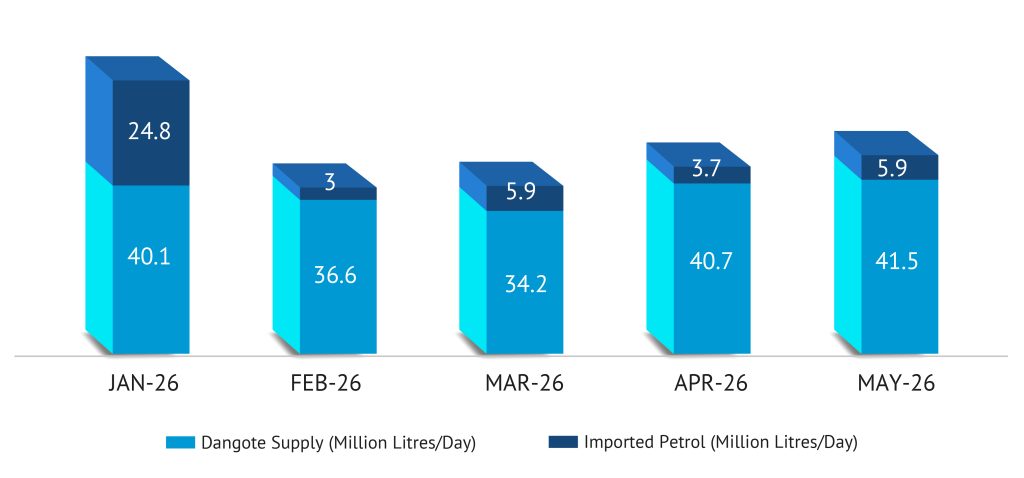
Source: NMDPRA
Policy Trade‑offs: FX Strategy vs. Downstream Competition
Against that backdrop, a persistent dollar‑pricing regime at the refinery compresses the competitive advantage it previously enjoyed under naira‑for‑crude and raises difficult policy questions for the government. If marketers are required to settle most of Nigeria’s PMS requirement in FX, the authorities must either find ways to ease access to dollars for these payments – through crude‑supply terms, FX market interventions, or regulatory pricing pressure – or accept that other importers will need greater latitude to bring in PMS when they can source product and FX at viable terms, even at the cost of renewed FX outflows. At this stage, the trade‑off remains largely implicit, surfacing mainly in market analysis rather than in formal government statements, but it underscores how Dangote’s commercial choices intersect directly with downstream competition, import policy, and the broader FX strategy.
Consequently, the government’s calculus regarding product importation has begun to shift. The original expectation was that ramp‑up of domestic refining capacity would progressively displace imported petroleum products from the core of the supply mix, narrowing the commercial space for imports over time. With Dangote now invoicing in dollars and operating under Free Trade Zone (FTZ) protocols, marketers are instead forced into the official or parallel FX markets to hunt for liquidity. Where the all‑in cost of sourcing those dollars – combined with the refinery’s ex‑depot price – converges with or exceeds the landed cost of imports from Europe, the local facility effectively erodes the purchasing advantage that naira‑for‑crude was designed to create.
In response to this emerging commercial friction, the authorities are actively keeping the import window open to prevent market vulnerabilities and a de facto single‑asset supply monopoly. The downstream regulator has recently approved fresh clean‑product import permits for the third quarter (July–September 2026) for major independent marketers, signalling an intent to preserve alternative supply channels even as domestic refining scales up. By maintaining multiple supply chains, the regulator provides marketers with a necessary commercial fallback against the refinery’s pricing power and mitigates the risk that dollar‑denominated domestic supply translates into unchallenged cost‑push pressure on pump prices. Ultimately, until a robust and enforceable naira‑for‑crude framework mandates naira‑linked invoicing at the refinery gate and ensures that domestic crude supply terms are consistent with that objective, structural pressure on the currency will persist, and petroleum importation will remain a necessary – albeit internally contradictory – hedge against domestic pricing monopolies.
Currency Contraction and Credit Vulnerabilities
The aforementioned internal FX tightening links directly to exchange-rate dynamics. As marketers bid for limited dollars to meet their payment obligations to the refinery, the marginal price of FX is likely to rise. The currency impact is heavily aggravated by the signal effect: when a flagship Nigerian industrial asset insists on dollar pricing, it signals a powerful vote of no confidence on the Naira, encouraging further dollarisation of contracts, pricing, and savings behaviour. This sits uneasily with the Central Bank’s FX Manual and broader legal framework, which reaffirm that naira is the mandatory legal tender for domestic transactions between Nigerian entities, with only tightly defined exemptions for specified activities in oil and gas, aviation, maritime and Free Trade Zones.
For lenders, Dangote’s dollar pricing materially elevates both FX and credit risk across the banking sector. The crux of the issue lies in the severe amplification of uncertainty within the downstream segment, driven by an acute currency mismatch: marketers generate their revenues entirely in naira, yet are now forced to take on FX-denominated or FX-linked loan obligations to finance local procurement. This structural imbalance triggers deep historical sensitivities for Nigerian financial institutions. Many lenders have previously sustained heavy losses and booked significant non-performing loans (NPLs) after financing downstream operators whose import models were decimated by sudden currency depreciations. Consequently, working-capital lines to marketers are becoming significantly more volatile. Banks are responding to this revived risk with defensive posturing – prompting tighter collateral demands, shorter tenors, and aggressive risk-based pricing. Ultimately, this financing environment will increasingly favour stronger, better-capitalised marketers with the balance-sheet resilience to absorb exchange rate shocks, while weaker, highly leveraged players will face severely constrained access to bank credit and trade finance.
Fuel Pricing, Inflation, and Macro Transmission
Replacing naira-denominated ex-depot prices with explicit dollar benchmarks effectively re-indexes domestic fuel prices to the exchange rate. Retail fuel prices are now a direct, real-time function of the global oil price benchmark, refining margins, and the naira-dollar rate. Any step depreciation of the naira now passes through immediately to the pump, generating heightened price uncertainty for households and firms.

This dynamic aggressively amplifies the inflation channel across several critical sectors:
- Transport & Logistics: Direct and immediate pass-through of higher pump prices (PMS at USD 0.779/litre) into elevated transportation fares and haulage costs.
- Agriculture: Higher distribution logistics costs drastically raise farm-to-market overhead, feeding directly into sustained food inflation.
- Services & Manufacturing: Sectors heavily reliant on off-grid diesel generators (with AGO pegged at USD 1.087/litre) will experience severe margin compression, forcing businesses to pass costs to consumers or face insolvency.
With wages adjusting slower than prices, real incomes erode, compressing consumption and weighing heavily on non-oil growth. In addition, downstream firms that earn naira revenues but must settle dollar liabilities to the refinery face acute currency-mismatch risk.
US-Iran Tensions, Oil Prices, and Nigeria’s Macro Outcome
The geopolitical backdrop is critical as the breakdown in US–Iran relations and renewed kinetic activity in and around the Strait of Hormuz has already pushed crude prices higher and increased volatility in global benchmarks. For Nigeria, as an oil exporter, higher oil prices would typically be expected to support FX earnings and reserves – provided production volumes are sustained and fiscal extraction does not fully absorb the windfall.
In the current configuration, however, the principal domestic supplier of refined products prices in dollars, so elevated international oil prices translate into more expensive crude feedstock in dollar terms and, by construction, higher dollar‑linked domestic fuel prices. Institutional constraints – such as crude theft, production shortfalls and operational bottlenecks – mean Nigeria is not fully capturing the upside of the ongoing Brent crude spike, leaving the economy exposed to more expensive fuel, imported inflation and only modest relief for the exchange rate.
Overall, Dangote’s shift to dollar pricing has increased Nigeria’s vulnerability to the present external energy and FX shock at a time of heightened geopolitical uncertainty. It raises onshore FX demand, strengthens the linkage between the naira and domestic fuel prices, and amplifies the inflationary consequences of the current phase of US–Iran tensions, unless offset by stronger oil production, more robust FX‑market architecture and credible efforts to capture and recycle whatever incremental FX inflows do materialise back into the domestic system.